Today the Church all over the world celebrates the Solemnity of the Body and Blood of Christ: Corpus Christi.
We pray for the faithful, that they may soon have access to the Eucharist, for the Body and Blood of Our Lord “is the source and summit of the Christian life. The other sacraments, and indeed all ecclesiastical ministries and works of the apostolate, are bound up with the Eucharist and are oriented toward it. For in the blessed Eucharist is contained the whole spiritual good of the Church, namely Christ himself, our Pasch” (Catechism of the Catholic Church, 1324).
Today, on this Solemnity, Our Holy Father Pope Francis reminds us: “The Eucharist brings us the Father’s faithful love, which heals our sense of being orphans. It gives us Jesus’ love…It fills our hearts with the consoling love of the Holy Spirit, who never leaves us alone and always heals our wounds…The Mass is the treasure that should be foremost both in the Church and in our lives. And let us also rediscover Eucharistic adoration, which continues the work of the Mass within us. This will do us much good, for it heals us within.”
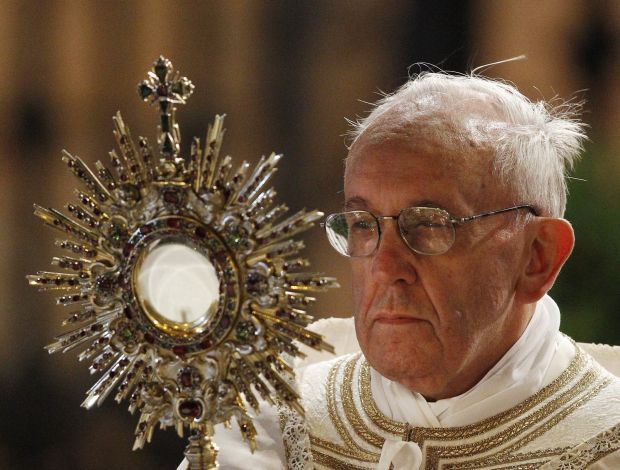
May our longing and love for Christ’s most Precious Body and Blood increase. As St. John Paul the Great teaches us: “The Church and the world have a great need of Eucharistic worship. Jesus waits for us in this sacrament of love. Let us be generous with our time in going to meet Him in adoration and in contemplation that is full of faith and ready to make reparation for the great faults and crimes of the world by our adoration never cease” (Dominicae Cenae, 3).
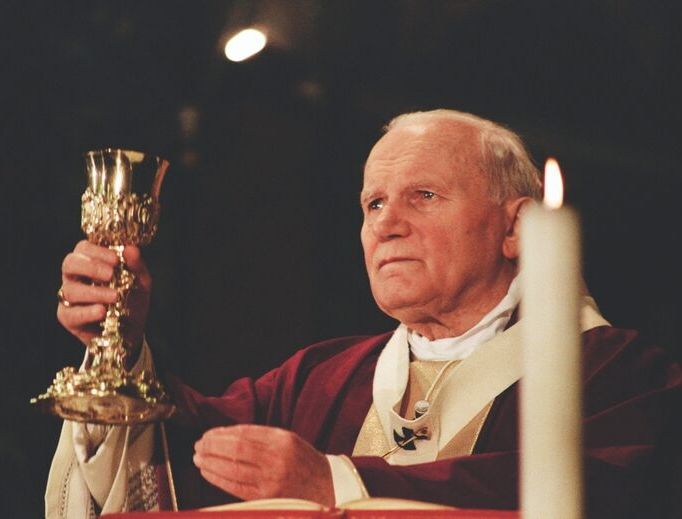
Though many cannot adore His Eucharistic Presence physically, the time of longing and waiting can be an offering of reparation and prayer, especially for peace in our world and in our nation.
Below is a beautiful and profound text of St. Thomas Aquinas, written for the Feast of Corpus Christi, reflecting on the mystery and power of the Most Blessed Sacrament.
St. Thomas Aquinas in honor of the Feast of Corpus Christi
(Opusculum 57, in festo Corporis Christi, lect. 1-4)
Since it was the will of God’s only-begotten Son that men should share in his divinity, he assumed our nature in order that by becoming man he might make men gods. Moreover, when he took our flesh he dedicated the whole of its substance to our salvation. He offered his body to God the Father on the altar of the cross as a sacrifice for our reconciliation. He shed his blood for our ransom and purification, so that we might be redeemed from our wretched state of bondage and cleansed from all sin. But to ensure that the memory of so great a gift would abide with us for ever, he left his body as food and his blood as drink for the faithful to consume in the form of bread and wine.
O precious and wonderful banquet, that brings us salvation and contains all sweetness! Could anything be of more intrinsic value? Under the old law it was the flesh of calves and goats that was offered, but here Christ himself, the true God, is set before us as our food. What could be more wonderful than this? No other sacrament has greater healing power; through it sins are purged away, virtues are increased, and the soul is enriched with an abundance of every spiritual gift. It is offered in the Church for the living and the dead, so that what was instituted for the salvation of all may be for the benefit of all. Yet, in the end, no one can fully express the sweetness of this sacrament, in which spiritual delight is tasted at its very source, and in which we renew the memory of that surpassing love for us which Christ revealed in his passion.
It was to impress the vastness of this love more firmly upon the hearts of the faithful that our Lord instituted this sacrament at the Last Supper. As he was on the point of leaving the world to go to the Father, after celebrating the Passover with his disciples, he left it as a perpetual memorial of his passion. It was the fulfilment of ancient figures and the greatest of all his miracles, while for those who were to experience the sorrow of his departure, it was destined to be a unique and abiding consolation.